Actually qualified leads, researched before you send
Search 300M+ contacts across 35+industry-leading data providers — then Gripwise cuts any account it can’t give you a dated, sourced reason for.
- contacts and companies to search
- 300M+contacts and companies to search
- industry-leading data providers
- 35+industry-leading data providers
- sourced reason per account, or it's cut
- 1sourced reason per account, or it's cut
Integrated with 35+ industry-leading providers · 1 credit per email, 25* per mobile, misses free*Business phone numbers from Google Maps listings cost 1 credit each.
How the waterfall works Hunter
 Findymail
 LeadMagic
 Wiza
Wiza Kitt
Kitt Datagma
 AI Ark
 Fiber AI
 Enrich Layer
 Aviato
 CompanyEnrich
 Apollo
 QuickEnrich
 PredictLeads
 Adyntel
 The Companies API
 Trestle
 MillionVerifier
 Scrubby
 Lusha
Lusha Prospeo
 Icypeas
 ContactOut
 Tomba
Tomba Leadsforge
 Dropleads
 Limadata
 Crustdata
 Ocean.io
 Exa
Exa People Data Labs
 Coresignal
 Sumble
 Diffbot
 Openmart
 HLR Lookup
 BounceBan
 LinkedIn
 Google Maps
 Indeed
 Glassdoor
 Yelp
Yelp Trustpilot
 Tripadvisor
 Product Hunt
 Google Ads
 Shopify
01What you can ask for
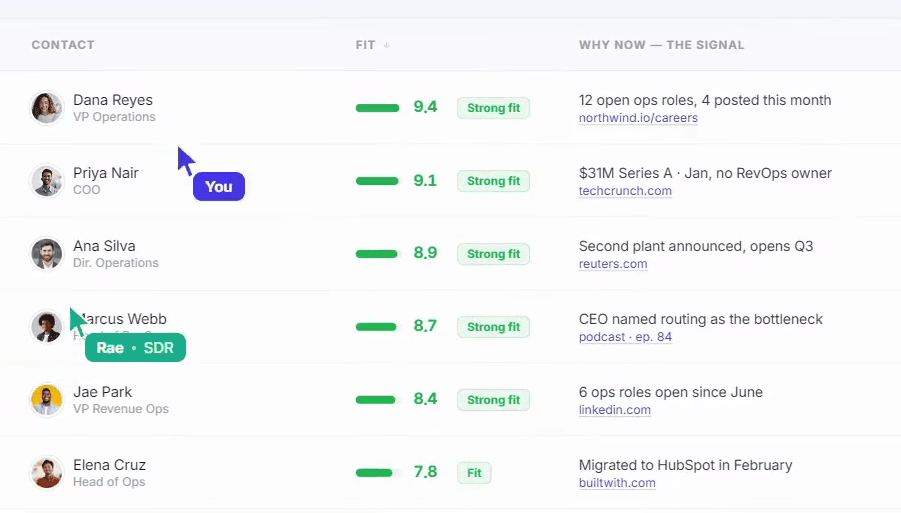
Any signal you can describe. Grip Radar checks every account for it.
Tell Grip Agent who you want and why now. Grip Scout finds the companies and people, Grip Radar checks each one for the signal, and anything without it is cut.
Team
Hiring for a role
Posted a Head of Sales role this month
Headcount growth
Sales team grew 30% this quarter
New leader in the seat
New VP Marketing, 60 days in
Champion moved jobs
A past buyer joined a new company
Money
Raised funding
Closed a Series A in the last 90 days
Running ads
14 live Google search ads this month
New location
Opened a second office in Denver
Online store
Shopify store doing steady volume
Product
Tech stack change
Added Salesforce, still on Mailchimp
Product launch
Launched on Product Hunt this week
Using a competitor
Runs a rival tool on their website
Changed their pricing
New pricing page went live last week
Intent
On your website
Read your pricing page three times
Engaged on LinkedIn
Commented on your latest post
Talking about the problem
Posted on LinkedIn about the pain you solve
Unhappy reviews
“Never called back”, nine times
The point of the list
A list exists to tell you what to say and who should say it. Every other tool blasts. Gripwise qualifies the lead first, cites the source, and only then writes. Anything that ships without that is just contact data with extra steps.
02What an account carries
Five layers, and the last one is the one nobody else has.
Four of these you can buy somewhere. The fifth is built from your own team's mailboxes and LinkedIn accounts, and it's the reason the same list performs differently for you than for a competitor.
- Firmographics
- Industry, headcount, revenue band, region, entity structure. The coarse filter that decides whether an account is even in the market you sell to.
- Technographics
- What they run, what they've just adopted, what they've just dropped. Usually the difference between a relevant message and a guess.
- Triggers
- Funding, hiring, leadership changes, expansion, product launches, public posts. Dated, sourced, and the thing your first line is built on.
- People
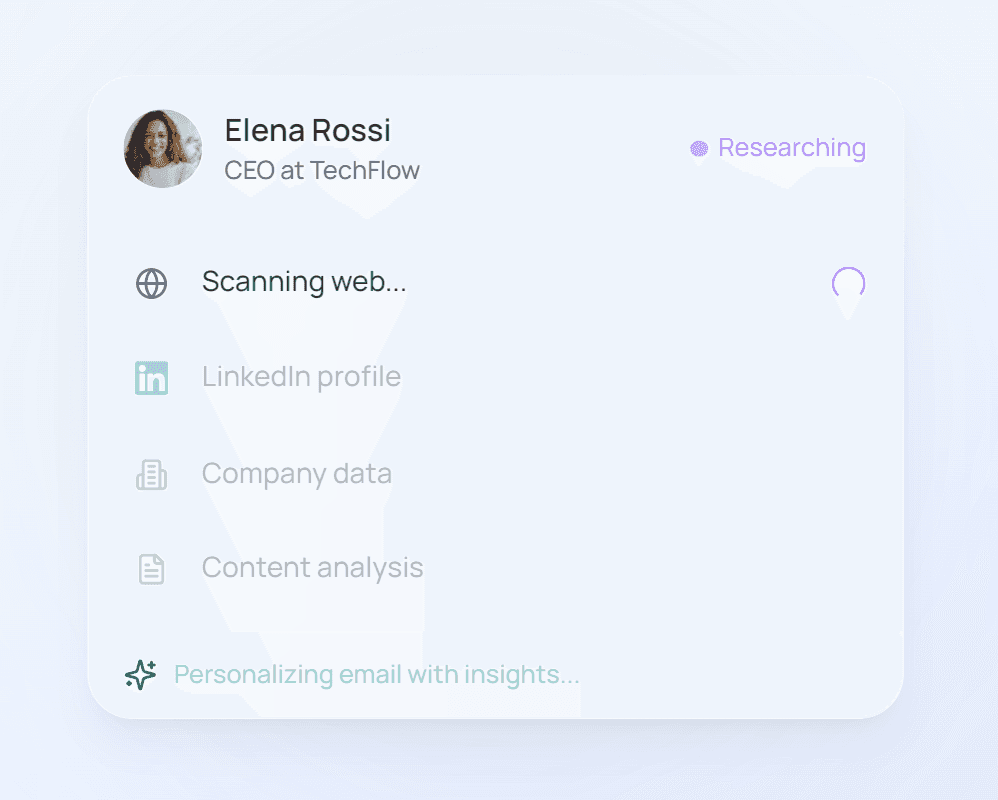
- The buying committee, not just one title. Role, remit, tenure, and contact details across email, mobile and LinkedIn, found through a waterfall of 35+ data providers.
- Verification
- Every address is checked before it reaches a campaign, against a shared cache so you never pay twice to verify the same person.
Bring your own list too
Upload a CSV and Gripwise runs the same pipeline over it — verifying, enriching, disqualifying and checking every row against your team’s network.
Inbound counts too
One script tag names the companies already on your site, so warm accounts join the same pipeline as everyone else.
03How a list gets built
Describe it once. Argue with the first fifty. Then let it run.
01Describe
Say who you sell to in plain English
No boolean query builder. Describe the customer, the trigger and the region the way you'd explain it to a new hire, and refine from the first fifty results.
02Build
The list assembles from live sources
Accounts are found, matched and enriched at query time, then scored against your definition so the ranking reflects fit rather than alphabet.
03Qualify
Everything that doesn't hold up gets cut
Each account gets a fact sheet with sources and dates. Anything without a defensible reason to contact is rejected — visibly, so you can argue with it.
04Sequence
Only the survivors get contacted
What's left flows straight into a multi-channel sequence, with each message written from the facts in that account's brief rather than a template.
04What gets thrown away
The quality of a list is decided by what you refuse to keep.
Every tool advertises how many contacts it finds. This is the part that actually moves your reply rate — and the part you should judge us on.
- Contact details that fail verification are dropped before a send is spent on them.
- Accounts with no dated trigger inside the window are held back, not padded with filler.
- Companies already in an active sequence anywhere on your team are excluded automatically.
- Existing customers and open opportunities are filtered out of prospecting lists by default.
- Anyone who has unsubscribed or asked not to be contacted is suppressed permanently, account-wide.
- Accounts that fail your own ICP rules are shown to you as rejected, with the reason, so you can tune the definition.
Smaller lists, on purpose
A researched list of four hundred accounts will out-perform a bought list of forty thousand, and it won’t cost you your sending domain to find out.